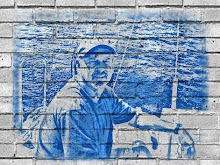
I just placed an order with McClain's for blocks and paper for my next woodblock prints. This will be the hardest and most time intensive project I've attempted. Ten color blocks plus the key block. I have a good picture in my mind of what I want to do, just worried (as usual) about registration. "In thePark' (at left) was printed with four blocks and my hardest to date.
Showing posts with label moku hanga. Show all posts
Showing posts with label moku hanga. Show all posts
Tuesday, March 15, 2011
NEXT WOODBLOCK PROJECT
I just placed an order with McClain's for blocks and paper for my next woodblock prints. This will be the hardest and most time intensive project I've attempted. Ten color blocks plus the key block. I have a good picture in my mind of what I want to do, just worried (as usual) about registration. "In thePark' (at left) was printed with four blocks and my hardest to date.
Wednesday, August 19, 2009
REDUCTION WOODBLOCK TECHNIQUE

I discoverd the web location below that shows how a reduction woodblock print is created. Andrea Rich has been doing woodcut prints since the early 1980s and her work is really very special.
Wednesday, June 17, 2009
MOKU HANGA TUTORIAL
Here is a link to a great video of the woodblock printmaking technique by Graham Scholes'
http://www.youtube.com/watch?v=dliF74ojOho
http://www.youtube.com/watch?v=dliF74ojOho
MOKU HANGA

Woodblock printing in Japan, (moku hanga) is a technique that was used very widely for printing books. It was also used in China for centuries to print books, long before the advent of movable type. The technique is essentially the same as that which is called woodcut in Western printmaking.
By the eleventh century, Buddhist temples in Japan were producing their own printed books of sutras, mandalas, and other Buddhist texts and images. For centuries, printing was restricted only to the Buddhist sphere, as it was too expensive for mass production, and did not have a receptive, literate public to which such things might be marketed.
It was not until 1590 that the first secular work would be printed in Japan. This was the Setsuyōo-shūu, a two-volume Chinese-Japanese dictionary.
The medium quickly gained popularity among artists, and was used to produce small, cheap, art prints as well as books.
The technology, though more tedious and expensive than later methods, was far less so than the traditional method of writing out each copy of a book by hand; thus, Japan began to see something of literary mass production.
It was not until 1590 that the first secular work would be printed in Japan. This was the Setsuyōo-shūu, a two-volume Chinese-Japanese dictionary.
The medium quickly gained popularity among artists, and was used to produce small, cheap, art prints as well as books.
The technology, though more tedious and expensive than later methods, was far less so than the traditional method of writing out each copy of a book by hand; thus, Japan began to see something of literary mass production.
Technique
The text or image would first be drawn onto Washi (Japanese paper), and then glued onto a plank of wood, usually cherry. Wood would then be cut away, based on the outlines given by the drawing. A small wooden hard object called a baren would be used to press or burnish the paper against the inked woodblock, thus applying the ink onto the paper.
The text or image would first be drawn onto Washi (Japanese paper), and then glued onto a plank of wood, usually cherry. Wood would then be cut away, based on the outlines given by the drawing. A small wooden hard object called a baren would be used to press or burnish the paper against the inked woodblock, thus applying the ink onto the paper.
Excerpts from Wikipedia
Subscribe to:
Posts (Atom)